How to choose the right electrically height-adjustable workbench
The purchase price is not the only factor to consider. Load capacity, frame stability, height adjustment range, options for future expansion and overall service life also matter. This article looks at the key criteria to help you choose a solution that suits your operation.
Height-adjustable tables were once mainly found in modern offices. As recently as around five years ago, electrically height-adjustable industrial workbenches were primarily used by larger companies and facilities operating around the clock, where the higher initial cost made economic sense. Today, they are also more affordable for smaller manufacturers. As a result, they are increasingly used in production facilities, logistics centres, assembly workstations and quality control. Companies are looking for ways to improve productivity and ergonomics while responding flexibly to changing production requirements.
In modern manufacturing, different operators often share a workstation and carry out different tasks. A fixed workbench height therefore rarely suits everyone. Poor working posture increases physical strain, leads to fatigue and, over time, can cause musculoskeletal problems.
Electrically height-adjustable industrial workbenches offer a solution. Their electrically operated telescopic legs allow the optimal working height to be set in a matter of seconds to suit the operator or the task. Compared with office models, they are designed for demanding industrial use, with greater load capacity, stability and durability in everyday operation.
Where height-adjustable workbenches are used
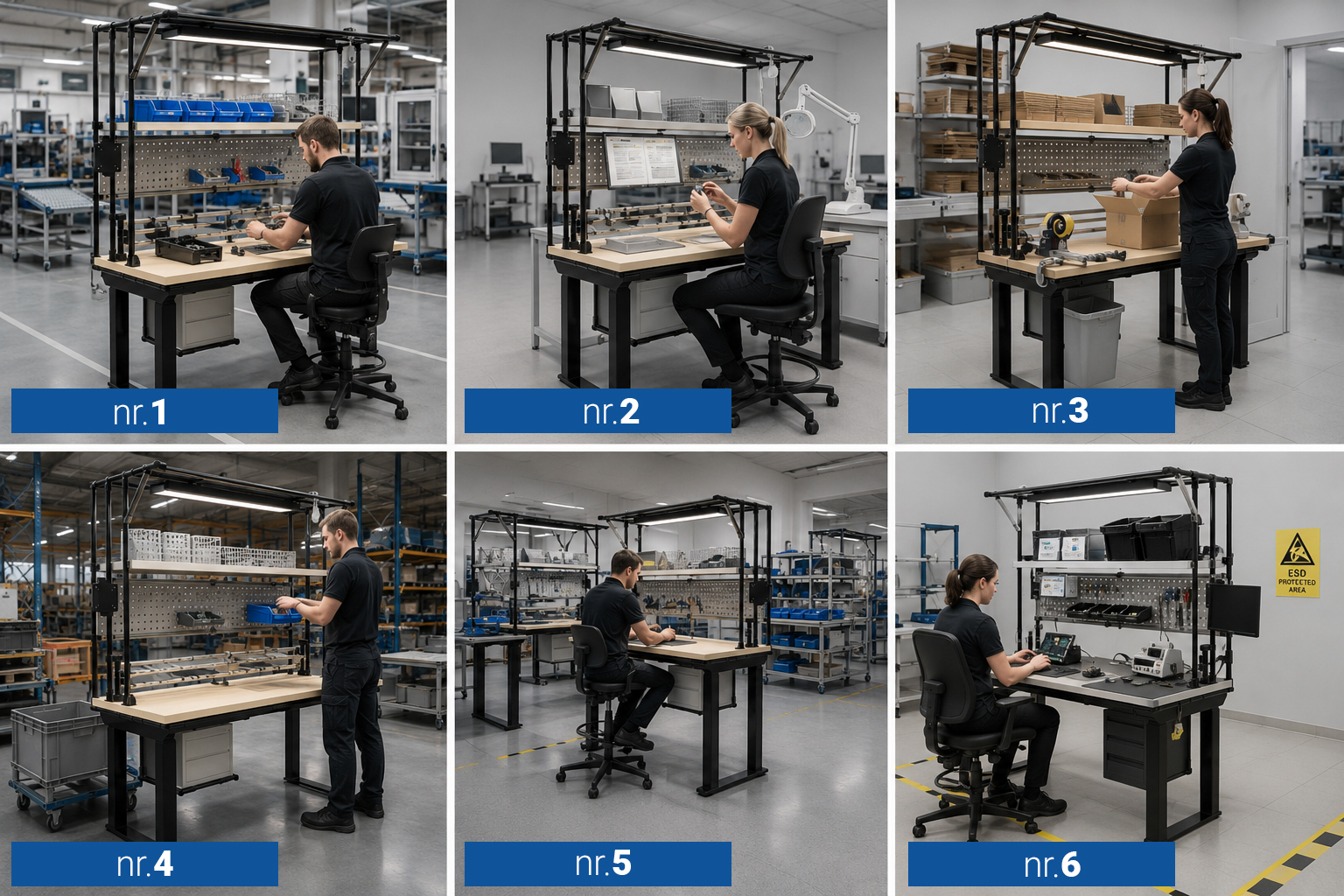
Electrically height-adjustable industrial workbenches are used in a wide range of manufacturing and logistics operations. They offer the greatest benefits where operators share workstations, production tasks change or workstations need to accommodate different products. ESD versions are also available for workstations that require sensitive electronic components to be protected against electrostatic discharge.
Assembly workstations
Assembly often involves components of different sizes. Electric height adjustment allows the working position to be adapted to the task in just a few moments, improving both comfort and precision.
Quality control
Visual inspection often depends on small details. The correct working height, combined with good lighting, helps reduce fatigue and supports accurate, repeatable inspection processes.
Packing and dispatch
The size of products being packed can vary considerably. Adjusting the work surface height makes cartons and products easier to handle and reduces unnecessary bending.
Logistics and intralogistics
Height-adjustable workbenches are also useful for order picking, sorting materials and preparing products for dispatch. Their height can easily be matched to handling trolleys, transport containers or roller conveyors.
Shared workstations
In multi-shift operations, several employees often use the same workstation. Each can quickly set the optimal working height, improving comfort and ergonomics.
Production with frequent product changes
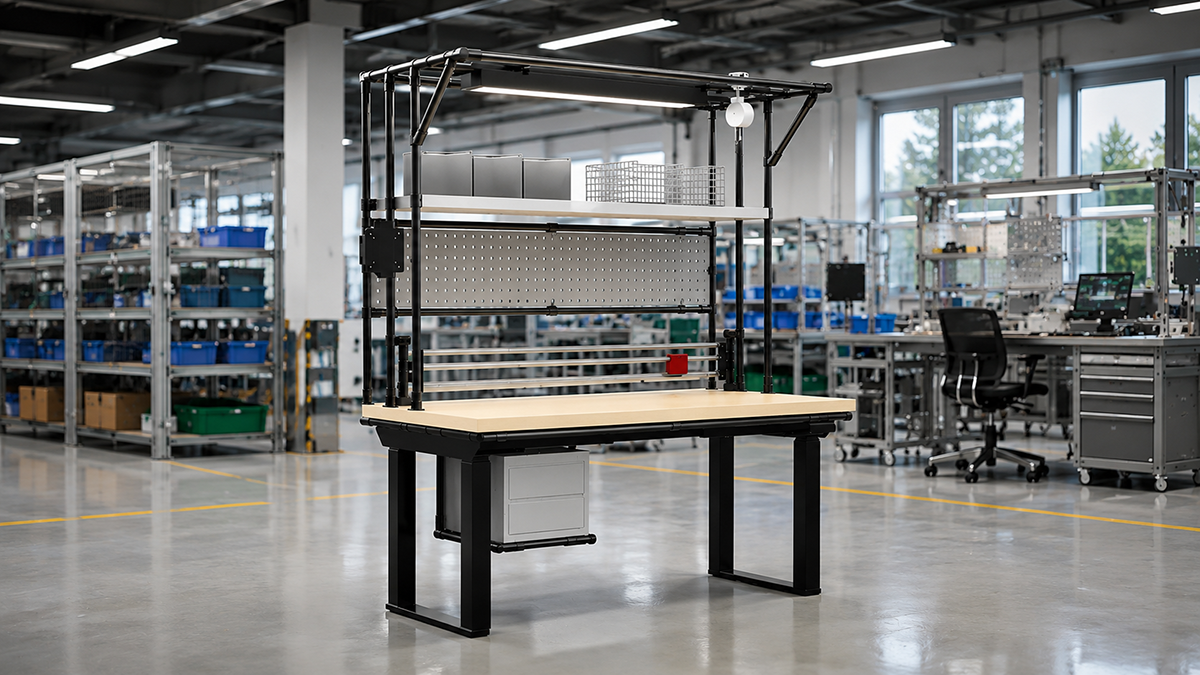
Custom and small-batch manufacturing require flexible workstations. A workbench that forms part of a modular system can easily be fitted with shelves, monitor mounts, material bins, roller conveyors or other accessories to meet current production needs.
How to choose the right workbench for your operation
An electrically height-adjustable industrial workbench is a long-term investment. A well-designed workstation can serve for many years and adapt to changing production requirements. When choosing one, it is therefore not enough to consider only the purchase price or load capacity. Frame stability, height adjustment range, expansion options and the way the workstation will be used also need to be assessed.
1.Consider the actual load
The workbench's load capacity needs to cover not only the product but also the worktop, fixtures, material bins, tools, monitors, shelves and other accessories.
It is worth allowing spare capacity for future expansion. Workstations often change over the years, and the frame should support additional equipment without compromising stability.
2.Stability is as important as load capacity
A high load capacity alone does not guarantee a good workbench. Even slight vibration of the worktop can affect accuracy when assembling small components or carrying out quality checks.
The frame should therefore remain stable throughout its height adjustment range, not just at its lowest position.
3.Height adjustment range
Every workstation has different requirements. In some settings, employees mainly work sitting down; in others, they stand or alternate between the two during a shift.
A sufficient adjustment range allows the working height to suit different operators and production tasks, making the whole workstation more versatile.
4.Simple controls support better ergonomics
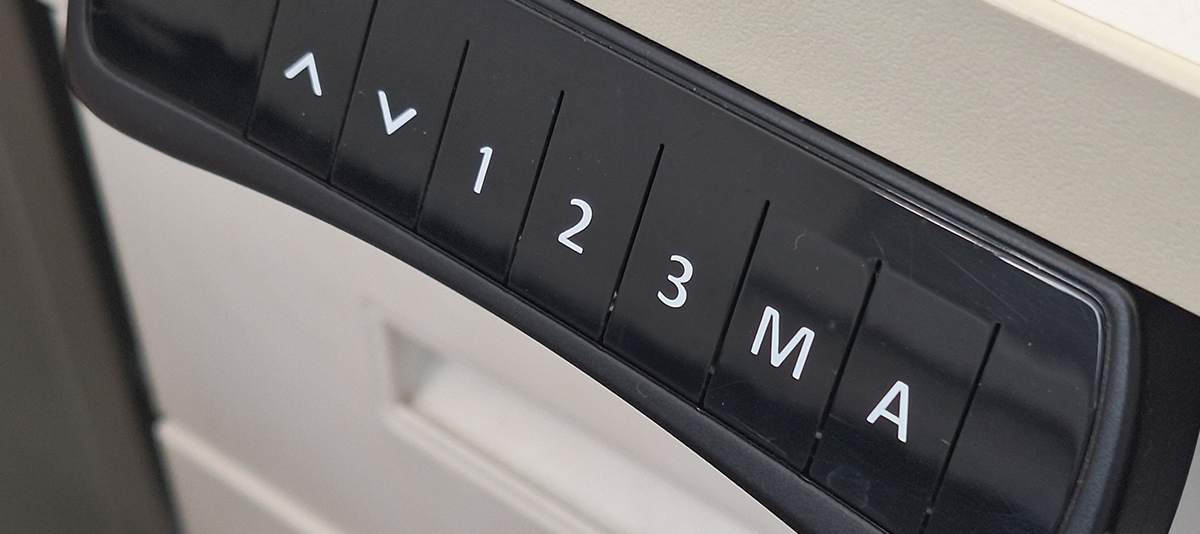
When height adjustment is quick and intuitive, employees are more likely to use it. Control panels that can store several preset heights are particularly useful. At shared workstations, each operator can then select the optimal position at the touch of a button. The Q223 range, for example, offers three memory positions for storing frequently used heights and switching quickly between them.
5.Modular construction supports future development
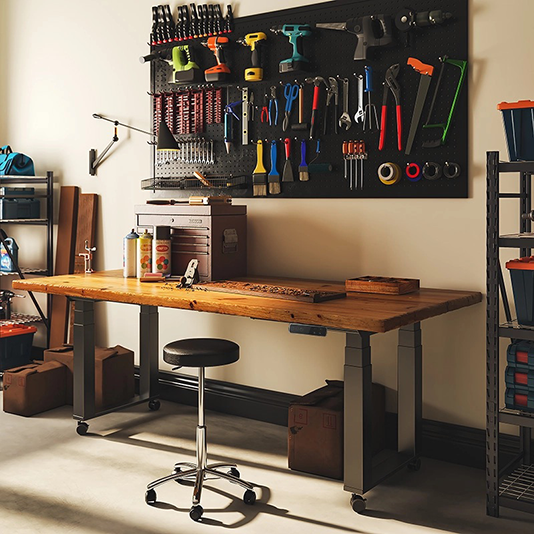
Production processes are constantly evolving. It is therefore worth choosing a solution that can be expanded easily without replacing the entire workstation.
Modular construction allows you to add, for example:
- shelves
- LED lighting
- monitor mounts
- tool holders
- material bins
- information boards
- electrical distribution
- roller conveyors
- handling accessories
This allows the workstation to adapt to new production requirements at minimal cost.
6.Assess the workstation as a whole
The workbench is just one part of a production workstation. Its full benefits emerge when it is combined with handling equipment, racking, roller conveyors, power supplies and properly positioned tools and equipment.
A well-designed workstation supports smooth material flow, reduces unnecessary movement and improves efficiency.
7.Think about the future
Designing a workstation around current needs alone can be short-sighted. The product range, production processes and technologies in use can change considerably over the years.
A flexible frame that can be modified and expanded easily is a better long-term investment than a solution designed solely for today's needs.
8.Every production operation has different requirements
There is no universal workbench that suits every operation. Its design should take into account the type of production, product size and weight, the number of operators, material handling methods and the company's planned development.
An individual design makes it possible to create a workstation that supports ergonomics, productivity and production flexibility over the long term.
Electric or manual height adjustment?
Electrically height-adjustable workbenches are ideal for operations where operators share a workstation, production tasks change during a shift or the working height needs frequent adjustment.
Typical applications include:
- shared workstations
- assembly lines
- custom and small-batch manufacturing
- workstations combining seated and standing work
- operations with frequent product changes
However, if the working height remains unchanged for long periods and the same employee always uses the workstation, a manually height-adjustable workbench may be more economical.
The decision should therefore be based not only on the purchase price, but above all on how the workstation will be used and the requirements of the particular production process.
Workstations designed around your operation
At Enprag, we design industrial workstations individually for each application. We consider the type of production, material flow, ergonomic requirements and opportunities for future development. The result is a solution that helps improve productivity, makes everyday work easier and can adapt to future production needs.
Our specialists will be happy to help you select and design the optimal solution for your operation. Together, we can develop a workstation that supports ergonomics, productivity and the future growth of your production.
Request a solutionAre you interested in anything else?
More articles
Nobo Automotive Systems Czech Republic s.r.o.: production equipment that adapts to change
Read the case study
Lean manufacturing methods: how to choose the right tool for your operations
Read the article
Aluminium Profiles in Industry
Read the article
When Lean Manufacturing Meets Metal Furniture
Read the article
Height-Adjustable Cart with Integrated Scale
Read the article