


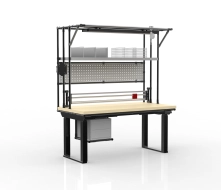
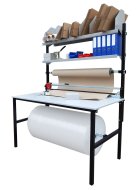

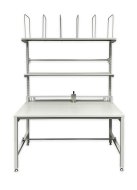

A packing table is often viewed simply as a piece of warehouse equipment, but in reality it is the place where the entire customer experience takes shape. It is here that products become parcels that will represent the company the moment customers first hold them in their hands. A packing table is therefore not only a workstation but also the final inspection point, the last opportunity to detect an error, and the last place where an impression of quality—or, conversely, carelessness—can be created.
Much more happens at a packing table than simply packing products. Employees must quickly assess the type of product, select the appropriate packaging materials, determine the best method of securing the shipment, verify documentation, prepare shipping labels, and often interact with warehouse management or information systems. The packing table is therefore the center of micro-logistics, where physical work and digital processes come together.
The quality of the packing table directly affects how quickly and accurately employees can make these decisions. A disorganized workstation leads to mistakes, delays, and unnecessary stress. By contrast, a well-designed packing table supports intuitive workflows and allows employees to focus on packaging quality rather than searching for materials.
An important yet often overlooked aspect is employee psychology. The pace of work at a packing table changes depending on the season, the type of products being packed, and current shipping demands. If the workstation is cluttered, overcrowded, or ergonomically unsuitable, employees quickly become overloaded. This results in mistakes that ultimately affect the customer—damaged goods, incorrect shipping labels, or missing items.
A clean, logically organized, and ergonomic workstation, on the other hand, promotes a calm and efficient working rhythm. Employees feel more confident, work faster, and make fewer mistakes. As a result, the packing table has a direct impact not only on productivity but also on employee satisfaction.
In logistics, the most expensive mistake is the one that reaches the customer. The packing table is the final place where errors can be identified, and its design can significantly support this process. Document holders ensure invoices and packing slips are inserted correctly, while organized shelving minimizes the risk of selecting the wrong materials. Packing tables can also be equipped with light-guided or digital systems that direct employees through the next step of the process. Some operations even use camera systems to document the packing process for potential claims or disputes. In this way, the packing table becomes a quality assurance tool rather than simply a place where products are packed.
Modern packing tables are also designed with material efficiency in mind. Proper placement of tape dispensers, film holders, and carton storage helps reduce the consumption of packaging materials. Employees have everything under control, minimizing unnecessary offcuts, excessive packaging, and the overuse of void fill materials.
A shipment is often the customer's first physical interaction with a company. Well-packaged products, clean packaging materials, accurate labels, and a professional presentation create a lasting impression that shapes brand perception. The packing table therefore plays an indirect but important role in marketing. It is the place where first impressions are created. Companies that recognize this invest in packing workstations not only to improve operational efficiency but also to ensure consistently high packaging quality. As a result, the packing table becomes an integral part of the company's culture and quality standards.