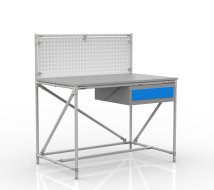
Workshop table from pipe system with perforated panel 240408313 (3 models)
Code: 240408313
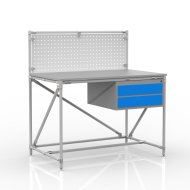
Workshop table with perforated panel from the tubular modular system. The table includes a laminate worktop, a table container with one drawer, a perforated panel and four adjustable legs. Load capacity with a uniform load of 100 kg. Dimensions 1282 x 1200 x 750 mm.
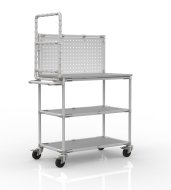
Table with folding mechanism 24091230
Code: 24091230
Table with folding mechanism made from a tubular modular system. The table includes a folding structure for securing trash bags, an 18 mm thick laminated worktop, two shelves with 10 mm thick Akyboard, four swivel wheels with brakes, each with a diameter of 100 mm, and a perforated panel for hanging tools or storage bins. The shelf load capacity is 50 kg, the worktop load capacity is 100 kg, and the total load capacity is 200 kg. Dimensions 1335 x 1029 x 498 mm, dimensions after folding the holder 1335 x 1595 x 498 mm.
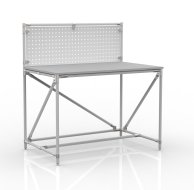
Workshop table from pipe system with perforated panel 240408312 (3 models)
Code: 240408312
Workshop table with perforated panel from the tubular modular system. The table includes a laminate worktop, a perforated panel with dimensions of 1117 x 393 mm and four adjustable legs. Load capacity with a uniform load of 100 kg. Dimensions 1282 x 1200 x 750 mm.
Workshop table from pipe system with perforated panel 240408314 (3 models)
Code: 240408314
Workshop table with perforated panel from the tubular modular system. The table includes a laminate worktop, a table container with two drawers, a perforated panel and four adjustable legs. Load capacity with a uniform load of 100 kg. Dimensions 1282 x 1200 x 750 mm.
Table container HDK-D03
Code: HDK-D03
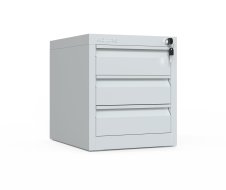
Hanging container with three drawers for a work table, height 380, width 330, depth 400 mm. 3x socket, color ESD gray RAL 7035.
Table container HDK-D03 width 500 mm
Code: HDK-D03_500
Hanging container with three drawers for a work table, height 380, width 500, depth 500 mm. 3x socket, color ESD gray RAL 7035.
Table container HDK-D02
Code: HDK-D02
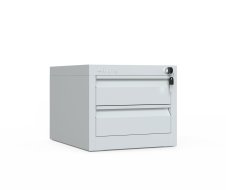
Hanging container with two drawers for a work table, height 280, width 330, depth 400 mm. 2x socket, color ESD gray RAL 7035.
Table container HDK-D02 width 500 mm
Code: HDK-D02_500
Hanging container with two drawers for a work table, height 280, width 500, depth 500 mm. 2x socket, color ESD gray RAL 7035.
Table container HDK-D01
Code: HDK-D01
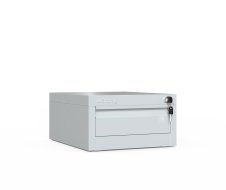
Hanging container with a drawer for a work table, height 180, width 330, depth 400 mm. 1x socket, color ESD gray RAL 7035.
Table container HDK-D01 width 500 mm
Code: HDK-D01_500
Hanging container with a drawer for a work table, height 180, width 500, depth 500 mm. 1x socket, color ESD gray RAL 7035.
Bracket set for Q-system QDN 5001
Code: QDN_50_01
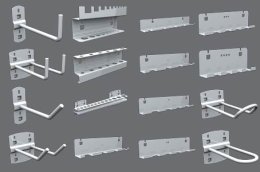
Set of brackets for the Q-system QDN 5001.
Shelf/work ESD board laminated on both sides, dimensions 1200 x 300 mm
Code: LDTD_1230_U1188MP
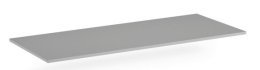
ESD chipboard laminated on both sides, light gray. Chipboard dissipating electrostatic charge according to EN 61340-5-1 designed for dry environments.
Shelf/work ESD board laminated on both sides, dimensions 1500 x 300 mm
Code: LDTD_1530_U1188MP
ESD chipboard laminated on both sides, light gray. Chipboard dissipating electrostatic charge according to EN 61340-5-1 designed for dry environments.
Worktop beech joint, dimensions 1200 x 750 mm
Code: BS_12754
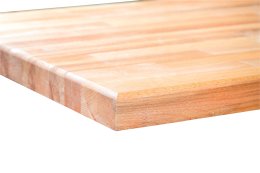
Worktops beech joint, width 1200 mm x depth 750 mm, thickness 40 mm. Made of continuously glued beech prisms, sanded and treated with a solution of linseed oil with additives, beveled upper peripheral edges.
Shelf/work ESD board laminated on both sides, dimensions 1800 x 300 mm
Code: LDTD_1830_U1188MP
ESD chipboard laminated on both sides, light gray. Chipboard dissipating electrostatic charge according to EN 61340-5-1 designed for dry environments.
Work ESD board laminated on both sides, dimensions 1200 x 900 mm
Code: LDTD_1290_U1188MP
ESD chipboard laminated on both sides, light gray. Chipboard dissipating electrostatic charge according to EN 61340-5-1 designed for dry environments.
What is lean manufacturing?
Lean manufacturing, also known as lean production, is a comprehensive system through which a company strives to achieve maximum efficiency and minimize waste in all areas of its operations. The principles of lean, often referred to simply as "lean," form the foundation of this strategy and include optimizing processes and eliminating unnecessary operations.
One of the key elements of lean manufacturing is the 5S method, which helps companies achieve better organization of the work environment. By applying the principles of 5S (Seiri, Seiton, Seiso, Seiketsu, Shitsuke), it is possible to use the workspace more efficiently and more easily identify and solve problems. Other significant methods within lean manufacturing include Lean Six Sigma, which focuses on identifying and eliminating the causes of errors and defects, and the Kanban method, which is used to visualize work processes and monitor the flow of materials, as well as the SMED method.
Although the concept of lean manufacturing has its origins in the production system established in Henry Ford's factories, it is most commonly associated with the Japanese company Toyota.
Optimization of material flow through a flexible pipe system
The fundamental aim of lean manufacturing is to produce more with lower inventory, fewer workers, and using less space, all of which are associated with reduced costs. This is achieved through the use of assemblies, workstations, or Kanban racks, which provide comprehensive or partial lean solutions. These include shelving assemblies and work furniture made, for example, from aluminum profiles or pipe modular systems. An important component of these assemblies is roller tracks, which are used for moving parts, containers, packages, etc. Their use reduces the physical strain on workers and ensures faster, uncomplicated, and stress-free work.
The goal of using assemblies is to achieve stable, flexible, and standardized production through optimization and improved material flow. This goes hand in hand with reducing operating costs and increasing work productivity. Moreover, existing assemblies can be modified at any time and in any way without significant financial costs.
You can introduce lean manufacturing gradually
Contrary to the myths surrounding lean manufacturing, there's no need to implement radical changes throughout the entire company all at once. Yes, lean manufacturing can be applied across the board, but it's also possible to consider where it makes sense to start within the company. Lean management serves as a strategic approach to gradually introducing lean manufacturing, focusing on continuous process improvement and engaging employees at all levels of the organization. Thanks to the modular nature of the construction system, optimization of workflows can occur gradually. So, if you're considering implementing lean manufacturing principles in your company, start today. Even a small change can bring significant benefits to your company, which is invaluable in today's world. Our team offers comprehensive services – from solution design and visualization to on-site assembly. Contact us or visit our showroom directly.