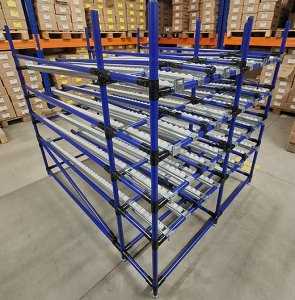


Powered conveyors
Belt, roller or plate conveyor: which one is right for you?
Conveyors are an integral part of many industrial and commercial facilities. They are used to transport usually dry and bulk material or piece goods from one place to another. They can be combined in various ways and expanded with other segments, thus creating larger and more efficient conveyor systems. Structural aluminum profiles tend to be our basic building element, making the structures highly customizable. The resulting conveyors are always configured according to the customer's requirements.
One of the main advantages of conveyor systems is their ability to move large volumes of material quickly and efficiently, which helps increase efficiency and improves overall workplace ergonomics. Conveyor systems typically consist of a belt, chain, or rollers that move materials along a predetermined path, powered by an electric motor or other power source.
Basic types of conveyors:
-
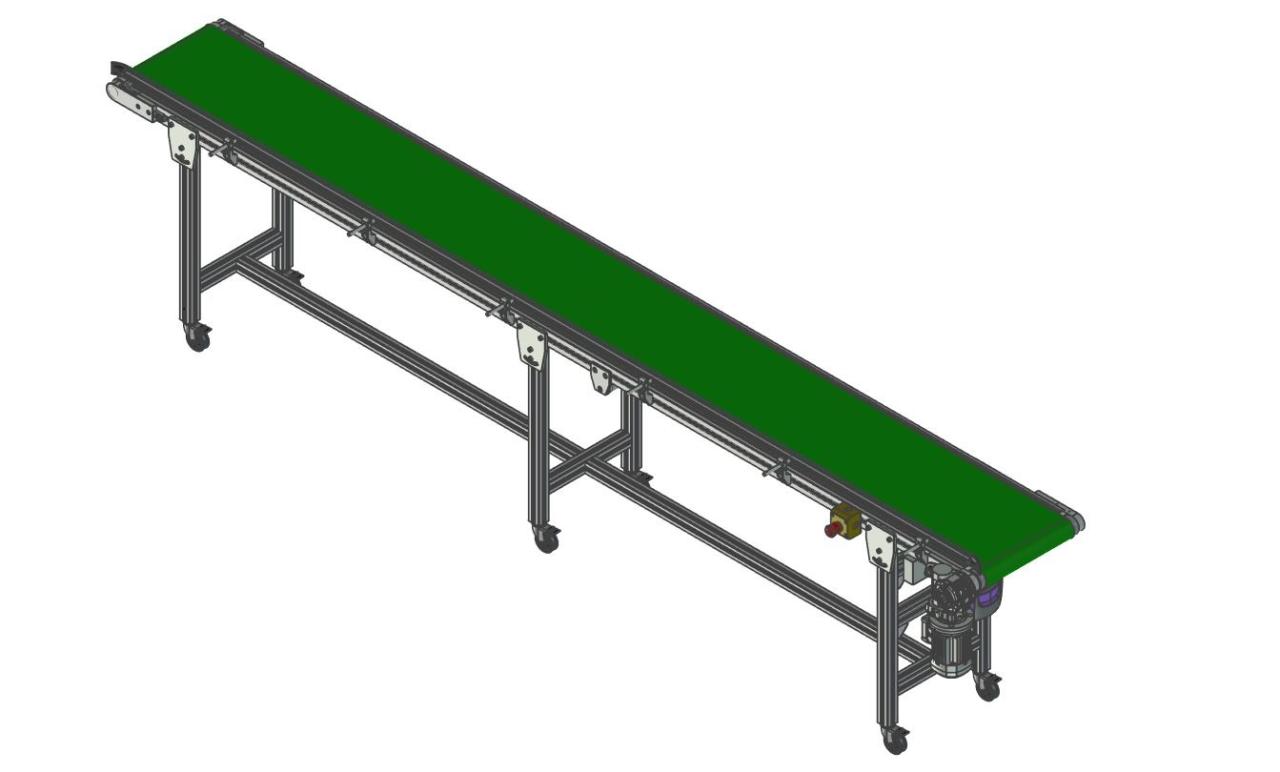
Belt conveyor – a PVC or rubber belt that is attached to rollers or a sliding surface. It is used for transporting not only bulk materials, but also piece goods in distribution centers, airports or supermarkets.
-
Roller conveyor – consists of a series of rollers (or cones) which are placed in a fixed frame and form a continuous path. They can be powered or unpowered (gravitational). They are used for handling and transporting boxes, crates or products in distribution centers.
-
Screw Conveyor - A helical screw rotating inside a tubular casing or chute. It is used to transport loose materials such as grain, pellets, flour, granules or coal to the boiler.
-
Plate conveyor – consists of a series of plates placed on a flat chain. These plates create a continuous moving surface. This conveyor makes it possible to transport even narrow or small objects.
-
Bucket conveyor – pockets suspended on a belt or chain intended for transporting mainly loose materials. Transport takes place only vertically up to a height of 60 m.
-
Roller track – consists of a number of rollers that are located on several axes. Unlike the roller track, where the rollers are close to each other, the individual rollers are offset from each other. They are used to transport smaller and lighter objects that a roller track would have difficulty with.
Driven belt conveyors are most often used by our customers. This is machinery for transporting piece products to the required distance with use in various industries. They are made from a basic frame, a driving and driven cylinder, a support sheet and a conveyor belt. Two variants can be used for this type of conveyor. The first and more commonly used variant is the belt conveyor made of an aluminum structural system. Another option is a variant completely made of stainless steel parts and materials intended for the food industry or pharmacy.
Where and what are conveyors used for?
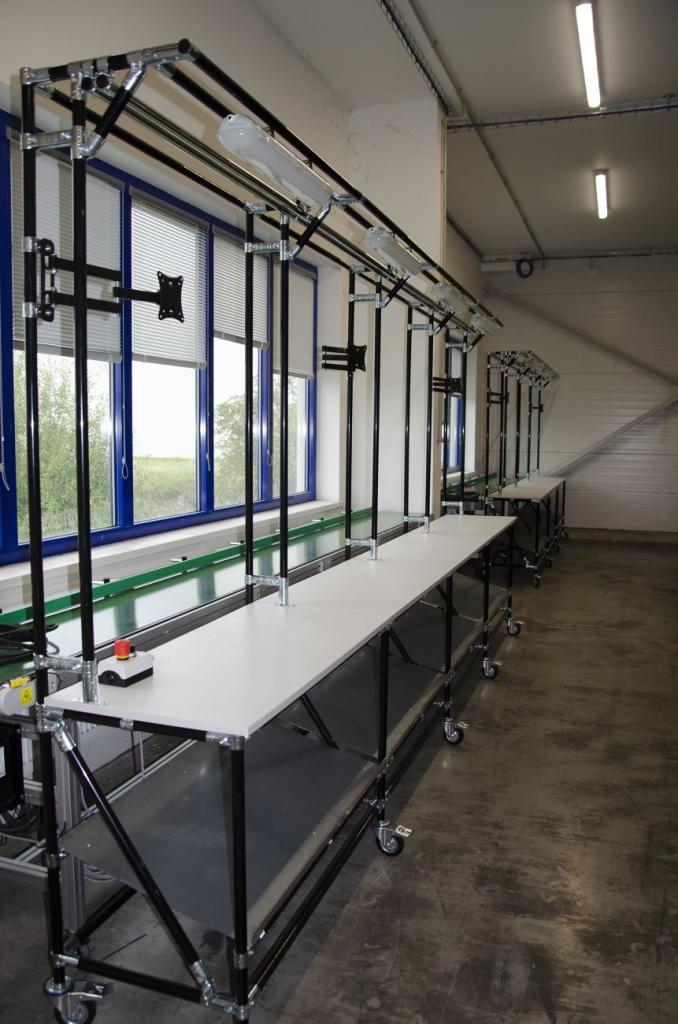
- part of automated production lines, in cooperation with other technological units, transportation of material in logistics centers, etc.
- operations with a technological operation performed directly on the conveyor
- indoor use under normal operating conditions
- transport of piece goods or complete handling units
- change in the direction, height and speed of the flow of transported material
- accumulation of transported material on the conveyor
When choosing a conveyor, you need to consider a number of factors, such as the type of material, size or weight of the transported goods. A properly designed conveyor can significantly increase the efficiency of the production process and reduce material handling costs. Each type of conveyor has its advantages and disadvantages, and it is important to choose the most suitable one for a specific application. Take a look at the ready-made structures or contact our experienced experts, who will be happy to help you come up with a tailor-made solution.
Are you interested in anything else?
More articles
Height-Adjustable Cart with Integrated Scale
Read the article
Logistics Cart with Textile Inserts
Read the article
Production Line Design and Implementation (One Piece Flow)
Read the article
Find the height of your work desk
Read the article
Kanban Method Step by Step
Read the article