

Kanban Method Step by Step
Simple Work Management System
Effective work management is not just about systems and speed, but primarily about clarity and smooth process flow. One of the simplest and most effective tools is the Kanban method.
Kanban comes from Japanese and means “visual signal” or “card.” It was originally developed in the Toyota Production System to manage production and inventory. Today, it is used not only in manufacturing and logistics but also in office environments, for example in software development or project management.
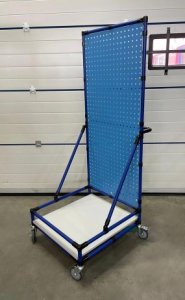
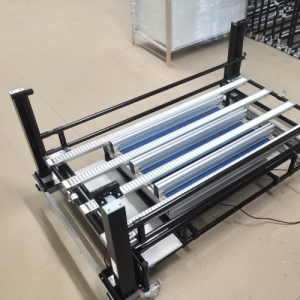
One of the products that supports the Kanban method is the flow rack.

Basic Principles of Kanban
Kanban is based on three simple rules:
- Visualize the work – so it’s clear what is happening at any moment.
- Limit work in progress (WIP) – don’t do more at once than you can handle.
- Manage the flow of work – gradually fine-tune the process so everything flows smoothly.
Kanban Explained Step by Step
Imagine a process where tasks move from one stage to another:
- “To Do” – new tasks waiting to be started.
- “In Progress” – tasks currently being worked on.
- “Review” – tasks waiting for inspection or approval.
- “Done” – completed tasks.
Work in Progress (WIP) Limit
Each stage has a limited capacity. For example, if a maximum of three new tasks is allowed, only three tasks can enter that stage at the same time. This prevents overload and slowdowns, helps the team learn to complete work, and makes the process smoother and more efficient.
How Kanban Works Step by Step
- A task enters the process – it is added to the “To Do” stage.
- A worker starts the task and moves it to “In Progress” if capacity is available.
- After the work is done, the task moves to “Review”, where it is checked.
- After approval, the task ends up in the “Done” stage.
Tasks move gradually through the stages until they are fully completed.
Why Kanban Works
Kanban is a simple and visual tool that provides real benefits:
- Overview at a glance – you can see how much work is in progress, where bottlenecks occur, and who is available.
- Higher efficiency – WIP limits prevent team overload.
- Better quality – the team has space to solve problems and work thoroughly.
- Natural process optimization – delays and overloads show where communication or control needs improvement.
Other Enprag products supporting the KANBAN method.


Shelf Trolley for KLT Containers Double-Sided Trolley for Hanging KLT Containers
Just like the 5S method, Kanban is a simple tool that can significantly improve efficiency, clarity, and work quality. It helps to see the entire process as a well-organized flow of tasks, where work progresses smoothly from start to finish, the amount of work in progress is limited, and everyone knows what is happening.
Would you like advice on how to implement Kanban in your organization? Contact us.
Are you interested in anything else?
More articles
Height-Adjustable Cart with Integrated Scale
Read the article
Logistics Cart with Textile Inserts
Read the article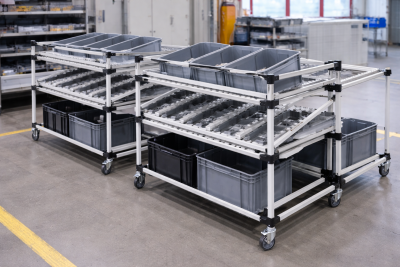
Production Line Design and Implementation (One Piece Flow)
Read the article
Find the height of your work desk
Read the article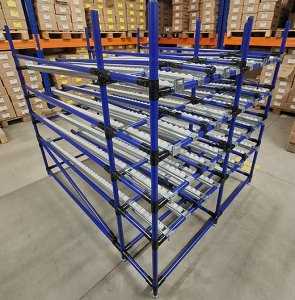
Gravity flow rack with roller tracks
Read the article